The Empty Menagerie considers the circus not as a site of spectacle, but as a ruin after its final performance has evaporated from memory. A weathered tent rises from an eroded terrain marked by stitched seams, barbed thread, tracks and scattered ticket-shaped fragments that still show the residue of bird-like fashionista portraits.
The Corvidae move through the abandoned grounds as witnesses, scavengers, and possible survivors. They occupy empty bleachers, balance near the ladder, gather along the tracks, and confront the imposing black figure in the foreground: a plague-doctor silhouette wearing the hat inscribed “circusus ingressus.” The figure looks upon the scene of a failed time, thinking of a forgotten spectacle.
The central form is deliberately uncertain. It may be a collapsed circus tent, a mountain, a monument, or a remnant of an institutional structure. Yellow-gold patches and a visible seam offer modest gestures of repair, but they cannot fully restore what has been worn down and abandoned. The curved rail line and looping thread imply movement and confinement at once: routes that lead onward, but also circles that cannot easily be escaped.
The work asks what remains when the performance ends and its systems of access, entertainment, labor, and control are left exposed. Here, the circus becomes an archaeological landscape. It’s a warning. Or, is it part memorial and part invitation to imagine what might gather in the silence between destruction and wandering?
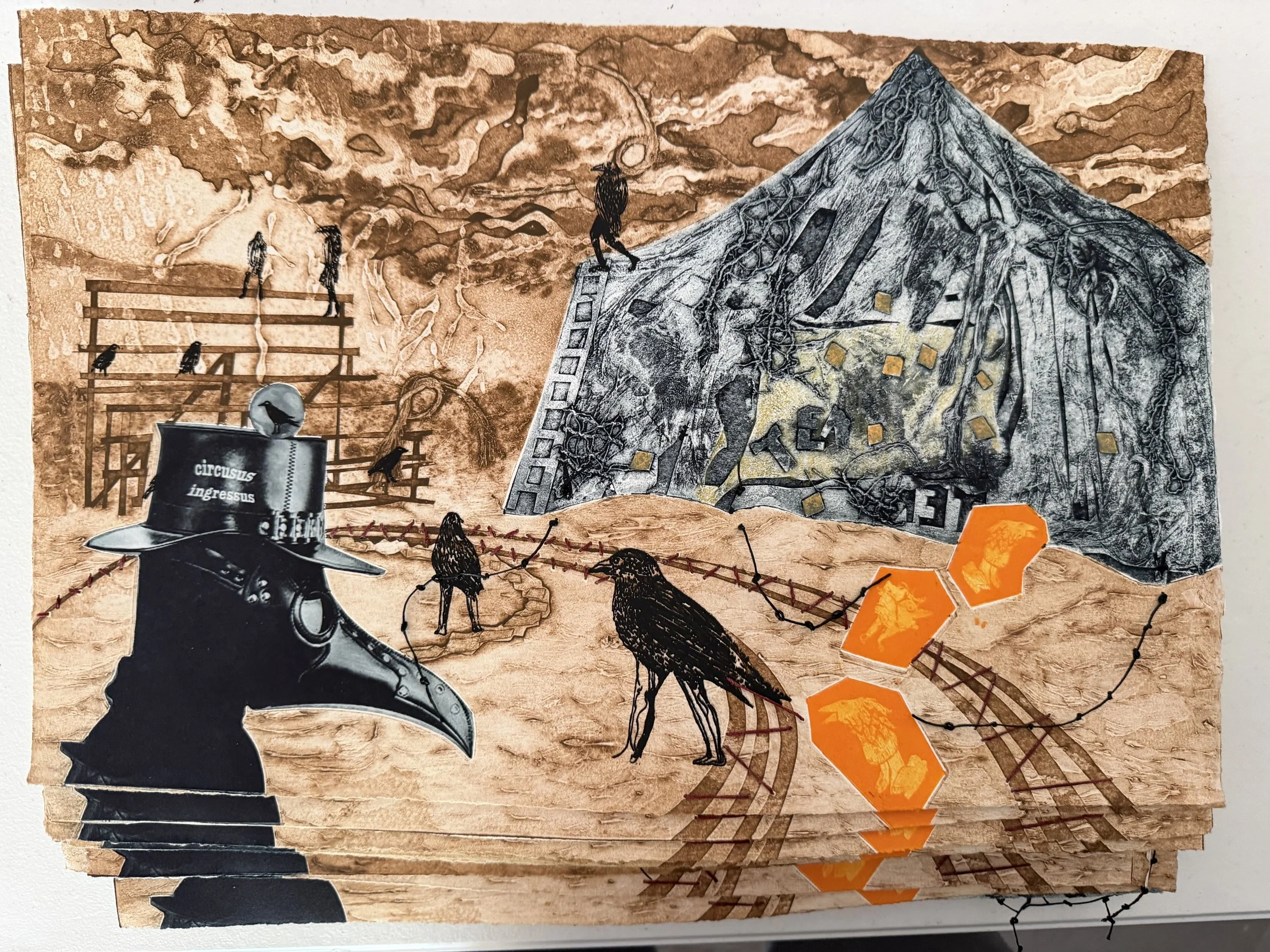
The Empty Menagerie, Collagraph, Photopolymer Intaglio, Stitched Thread, 2026
Size: 11” x 17”
Edition: 25
Artist Proofs and Variations: 5
This print was created for a print exchange: Welcome to the Circus! organized by Alana Austin, Institute of American Indian Arts, Santa Fe, NM
Circusus Ingressus
At the edge of the last mapped district, where the sand had begun to bury the rails, the Corvidae found the circus.
No one knew how long it had stood there. Its tent had become the color of ash and old bone, raised against the dunes like a mountain that had learned to imitate shelter. The canvas was split along its spine, but someone, or something, had begun to repair it with yellow bursts of light. From a distance, it looked like sunlight trying to hold the ruin together.
The entrance had no gate, only a frozen figure in black standing beneath a top hat. Its long beak faced the road. The words on the brim had faded almost beyond reading: Circusus ingressus.
Enter the circus.
The old languages are unreliable. They had been used too often by institutions that disappeared, by governments that renamed the roads before abandoning them, by companies that promised passage while quietly closing every exit. The Corvidae no longer trusted words that sounded like invitations.
Still, the Corvidae gathered.
They settled on the empty bleachers where spectators had once gathered in rows, waiting to be astonished. They perched on balancing poles, on broken rails, and on the rungs of a ladder leaning against the tent. Beneath their feet, the ground was threaded with dark lines: train tracks curling into the sand, barbed thread dangling in loose loops, and red thread that wandered from one fragment to another as if trying to remember the shape of a boundary.
The Corvidae had come to understand that every abandoned place retained a choreography. Even after the people left, the gestures remained: a ticket torn in half, a seat facing a ring, a rope stretched tight, an exit marked but never reached. The circus was full of these gestures. Its emptiness was not silent.
Inside the tent where the illusion of light played, the air smelled of dust and dry water.
There was no ring in the center—only a shallow windswept depression. A trail of orange plastic fragments circled the hollow, half-covered by sand. On each faded ticket was the image of a bird dressed for an occasion that had already ended: a raven in a collar, a crow beneath a brimmed hat, a magpie holding something bright in its beak. The portraits had once been comic, perhaps glamorous.
Now they looked like nostalgic remnants.
One young crow asked whether the birds had been performers.
An elder answered that they might have been witnesses.
“What is the difference?” asked the crow.
The elder did not reply.
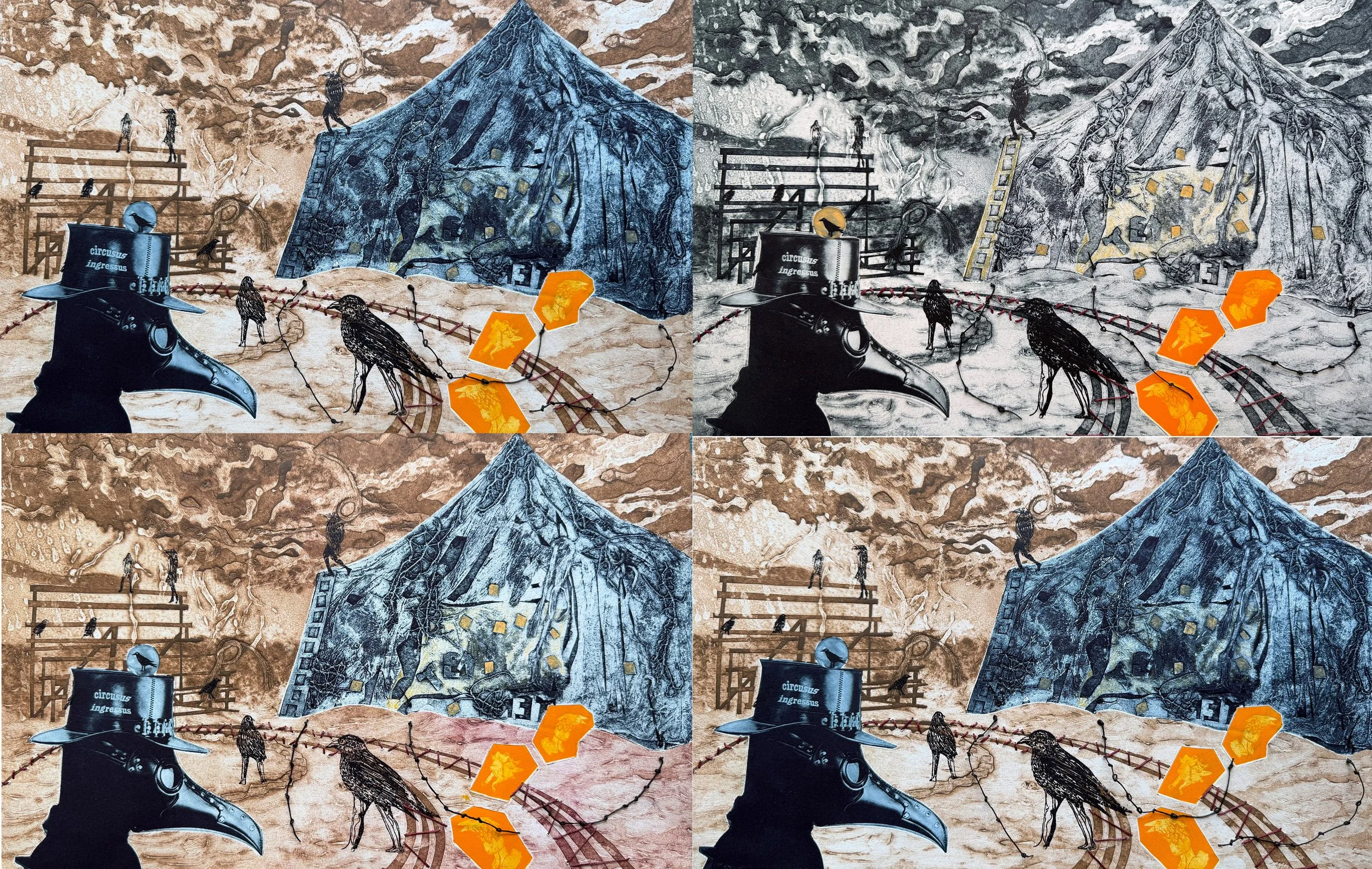
The Empty Menagerie - Variations, Collagraph, Photopolymer Intaglio, Stitched Thread