Liminal Birds, Salted Roots, Warm Hands
Liminal Birds, Salted Roots, Warm Hands is about a recipe not written on cards. The food that holds so many memories in our family, the Pasty, was shared from mother to daughter as a gathering more than a text: women and girls leaning over flour-dusted tables, narrating as they worked, learning by the weight of dough in our palms, by the way a thumb and forefinger find the edge and crimp without thinking. Each girl deciding for herself how mush of the dough would be crimped, how much meat, potatoes, onions would be placed in each pasty…There was no single, authoritative card pinned to the fridge; the recipe lived in voices, in repetition, in the time it took to peel potatoes and tell the same family stories.
When my mom, Carla Bravo, and I started looking for the red strings of our female line in official genealogy records, we found almost nothing about my great grandmother Grace (who was accredited with teaching my Grandma Edith… just a genealogy entry for the man who married her in Tonopah, a few pages devoted to his service, his work, his illness. Buried in that account was a phrase: “kids at home were watched over by Granny Elliott, a tough loving old bird and no-nonsense disciplinarian.” That “old bird” caught in my throat. It felt like a slip, an unintended bridge between the women who fed and policed the household and the crows and ravens that have been circling my work for years.
From that small phrase, the path bent back toward my own body of work, Road to Terminus. “Old bird” opened onto an imagined migration of people, of recipes, of words, of me thinking about the shifts between names and nations, onto what is remembered and what is lost. It pushed me into deeper research about family movement from Ukraine to Nevada, about Cornish pasties and mining towns, about how memory latches onto food.
This zine is an attempt to honor that double archive: the public one of forms and certificates and military records that barely register the women who held everything together, and the private one of kitchens, shared labor, and recipes that could only be learned by showing up. It is research torn up into poetic vignettes. It is the pasty recipe written down. Crows and ravens move through these pages as they move through the landscapes of Road to Terminus, companions to migrants and “old birds” alike, reminding us that what passes from hand to hand can outlast what is written down.
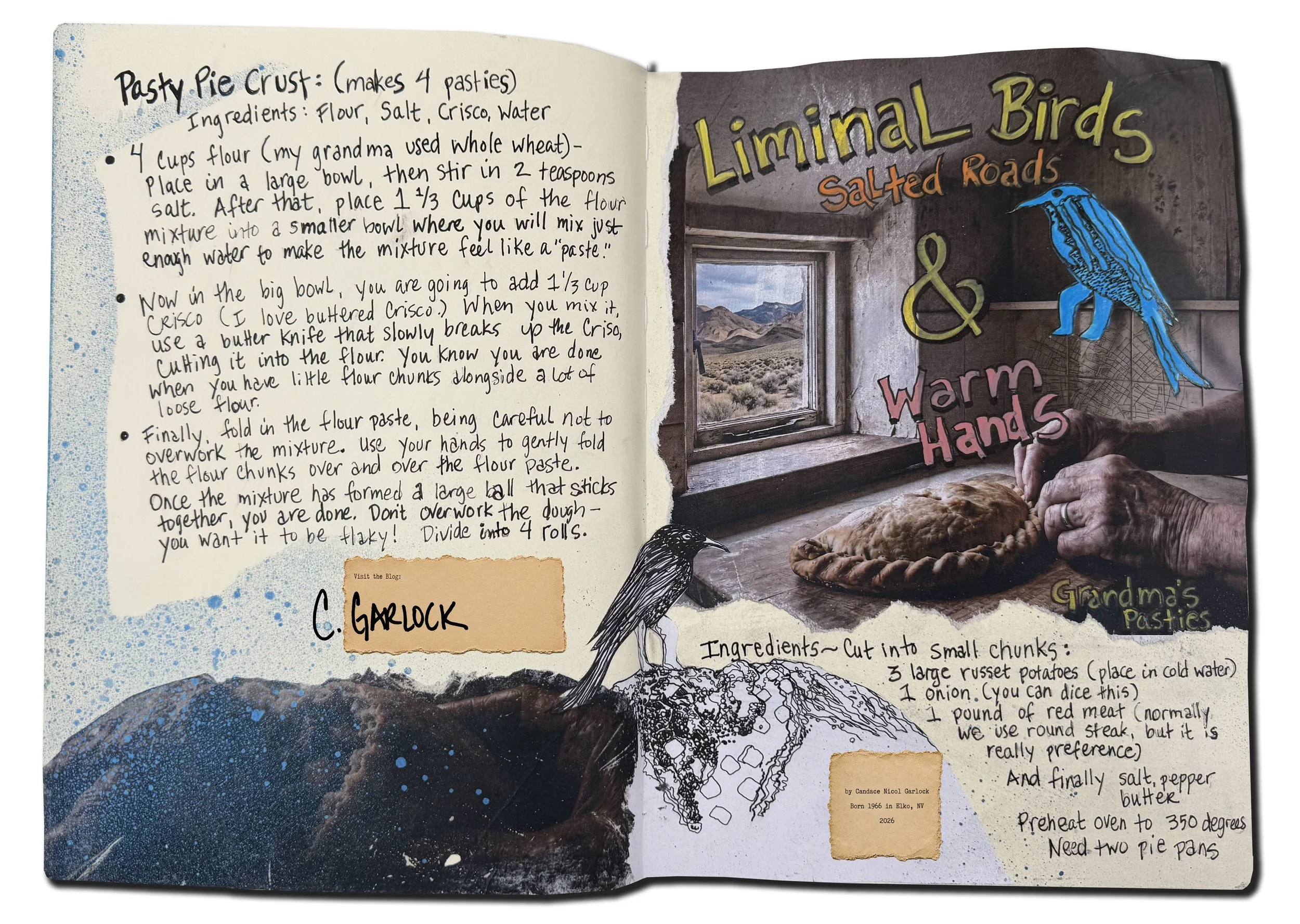
Recipe Card Front - Candace Garlock 2026
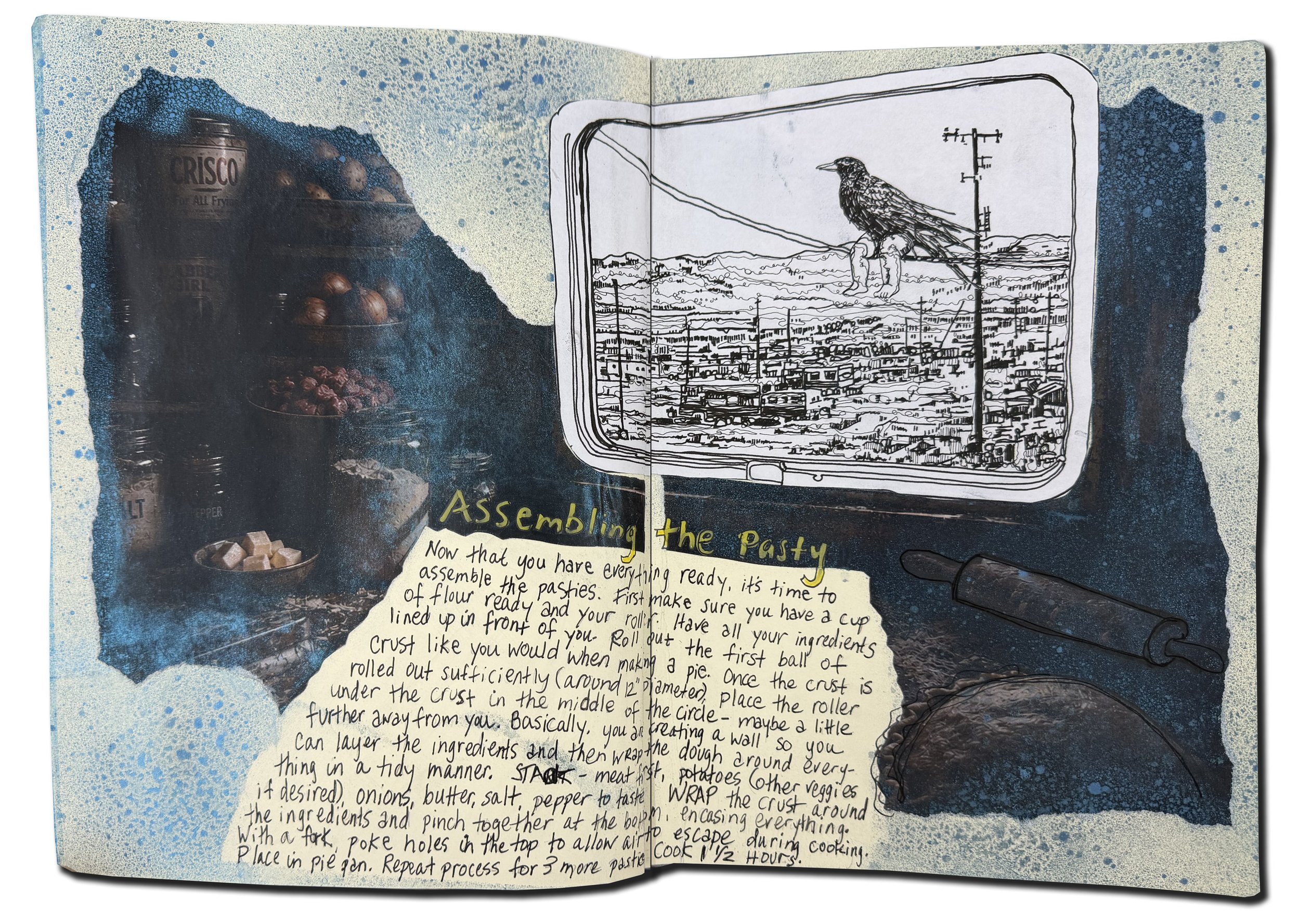
Recipe Card Back - Candace Garlock 2026
Liminal birds, the first of them, might have been the crows over a small village in the Carpathian foothills, calling his name before it settled on paper. In one version of the story, he is Anthony Charles; in another, Anton Bogdan; in another, Anthony Cazimir “Can” Bogdon—each name like a black feather dropped on a different document. A certificate says “Pissaarwk, Russia,” another says “Ivano-Frankisvk, Ukraine,” as if the village itself were migrating, sliding across inked borders. His parents’ names twist and Americanize—Francis becomes something else, Rosswod and Roset and Rose Sapir—all of them like dough worked and reworked until it fits the pan. Somewhere between those letters, a boy speaks Ukrainian, then halting English, his tongue learning to fold itself like pasty over a filling it is not sure will hold.
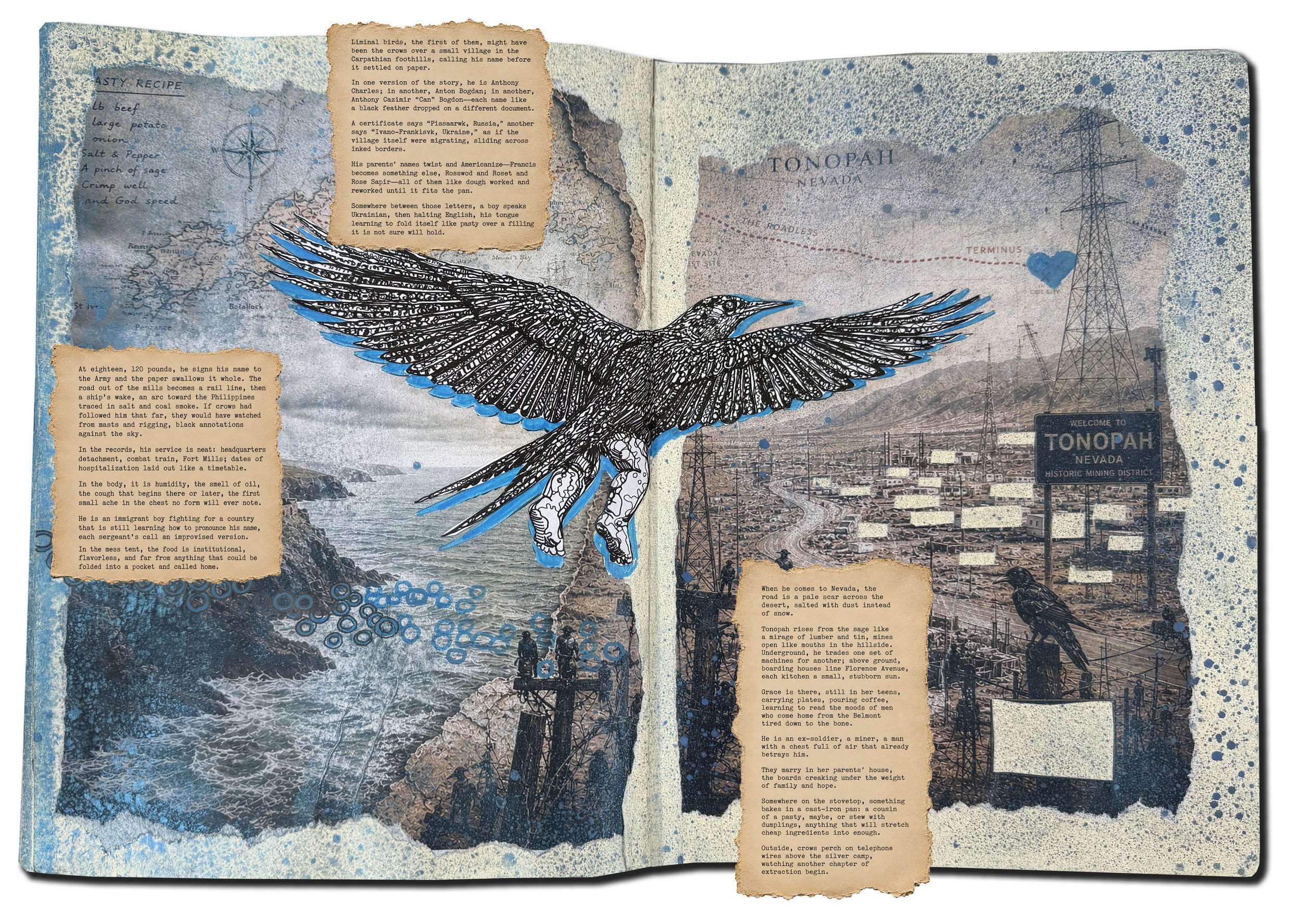
Liminal Birds, Salted Roots, Warm Hands Zine pages 7-8 - Candace Garlock 2026
When he comes to Nevada, the road is a pale scar across the desert, salted with dust instead of snow. Tonopah rises from the sage like a mirage of lumber and tin, mines open like mouths in the hillside. Underground, he trades one set of machines for another; above ground, boarding houses line Florence Avenue, each kitchen a small, stubborn sun. Grace is there, still in her teens, carrying plates, pouring coffee, learning to read the moods of men who come home from the Belmont tired down to the bone. He is an ex-soldier, a miner, a man with a chest full of air that already betrays him. They marry in her parents’ house, the boards creaking under the weight of family and hope. Somewhere on the stovetop, something bakes in a cast-iron pan: a cousin of a pasty, maybe, or stew with dumplings, anything that will stretch cheap ingredients into enough. Outside, crows perch on telephone wires above the silver camp, watching another chapter of extraction begin.
At eighteen, 120 pounds, he signs his name to the Army and the paper swallows it whole. The road out of the mills becomes a rail line, then a ship’s wake, an arc toward the Philippines traced in salt and coal smoke. If crows had followed him that far, they would have watched from masts and rigging, black annotations against the sky. In the records, his service is neat: headquarters detachment, combat train, Fort Mills; dates of hospitalization laid out like a timetable. In the body, it is humidity, the smell of oil, the cough that begins there or later, the first small ache in the chest no form will ever note. He is an immigrant boy fighting for a country that is still learning how to pronounce his name, each sergeant’s call an improvised version. In the mess tent, the food is institutional, flavorless, and far from anything that could be folded into a pocket and called home.
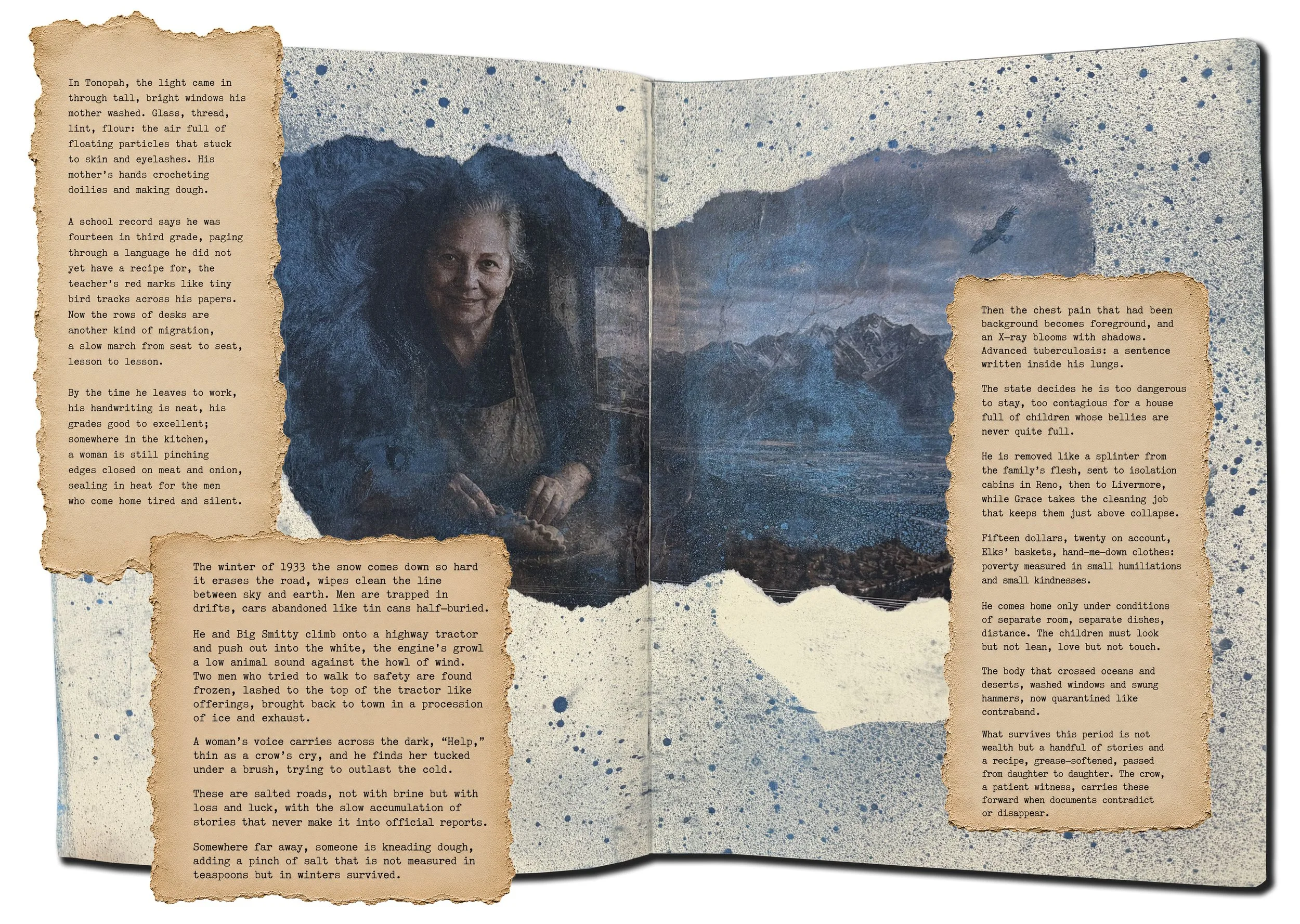
Liminal Birds, Salted Roots, Warm Hands Zine pages 11-12 - Candace Garlock 2026
In Tonopah, the light came in through tall, bright windows his mother washed. Glass, thread, lint, flour: the air full of floating particles that stuck to skin and eyelashes. His mother’s hands crocheting doilies and making dough. A school record says he was fourteen in third grade, paging through a language he did not yet have a recipe for, the teacher’s red marks like tiny bird tracks across his papers. Now the rows of desks are another kind of migration, a slow march from seat to seat, lesson to lesson. By the time he leaves to work, his handwriting is neat, his grades good to excellent; somewhere in the kitchen, a woman is still pinching edges closed on meat and onion, sealing in heat for the men who come home tired and silent.
The winter of 1933 the snow comes down so hard it erases the road, wipes clean the line between sky and earth. Men are trapped in drifts, cars abandoned like tin cans half-buried. He and Big Smitty climb onto a highway tractor and push out into the white, the engine’s growl a low animal sound against the howl of wind. They take turns walking ahead, feeling for the vanished road with their boots, their bodies as probes in the storm. Two men who tried to walk to safety are found frozen, lashed to the top of the tractor like offerings, brought back to town in a procession of ice and exhaust. Another night, a woman’s voice carries across the dark, “Help,” thin as a crow’s cry, and he finds her tucked under a brush, trying to outlast the cold. These are salted roads, not with brine but with loss and luck, with the slow accumulation of stories that never make it into official reports. Somewhere far away, someone is kneading dough, adding a pinch of salt that is not measured in teaspoons but in winters survived.
On April 3, 1941, he and Grace buy their first house, close to the power substation’s steady hum. Seven hundred dollars for wood and plaster and a yard that will carry the footsteps of six children. He adds an indoor bathroom, closes in porches, turns thin walls into a thicker shelter with his own hands. In the evenings, after railroad shifts and carpentry and bar-tending at the Ace Club, his hands move from hammer to spoon to the soft give of dough on a floured table. Times are good enough to drive a 1936 Ford to Long Beach, to stand at the 1939 World’s Fair, to imagine that the worst might be behind them. In the kitchen, warm hands pass plates, wipe faces, teach small fingers to crimp edges, to seal in meat and potato against the Nevada cold. Outside, ravens sit on the power poles, their bodies black against the desert light, watching the house pulse like a low, steady heart.
Then the chest pain that had been background becomes foreground, and an X-ray blooms with shadows. Advanced tuberculosis: a sentence written inside his lungs. The state decides he is too dangerous to stay, too contagious for a house full of children whose bellies are never quite full. He is removed like a splinter from the family’s flesh, sent to isolation cabins in Reno, then to Livermore, while Grace takes the cleaning job that keeps them just above collapse. Fifteen dollars, twenty on account, Elks’ baskets, hand-me-down clothes: poverty measured in small humiliations and small kindnesses. He comes home only under conditions of separate room, separate dishes, distance. The children must look but not lean, love but not touch. The body that crossed oceans and deserts, washed windows and swung hammers, now quarantined like contraband. What survives this period is not wealth but a handful of stories and a recipe, grease-softened, passed from daughter to daughter. The crow, a patient witness, carries these forward when documents contradict or disappear.
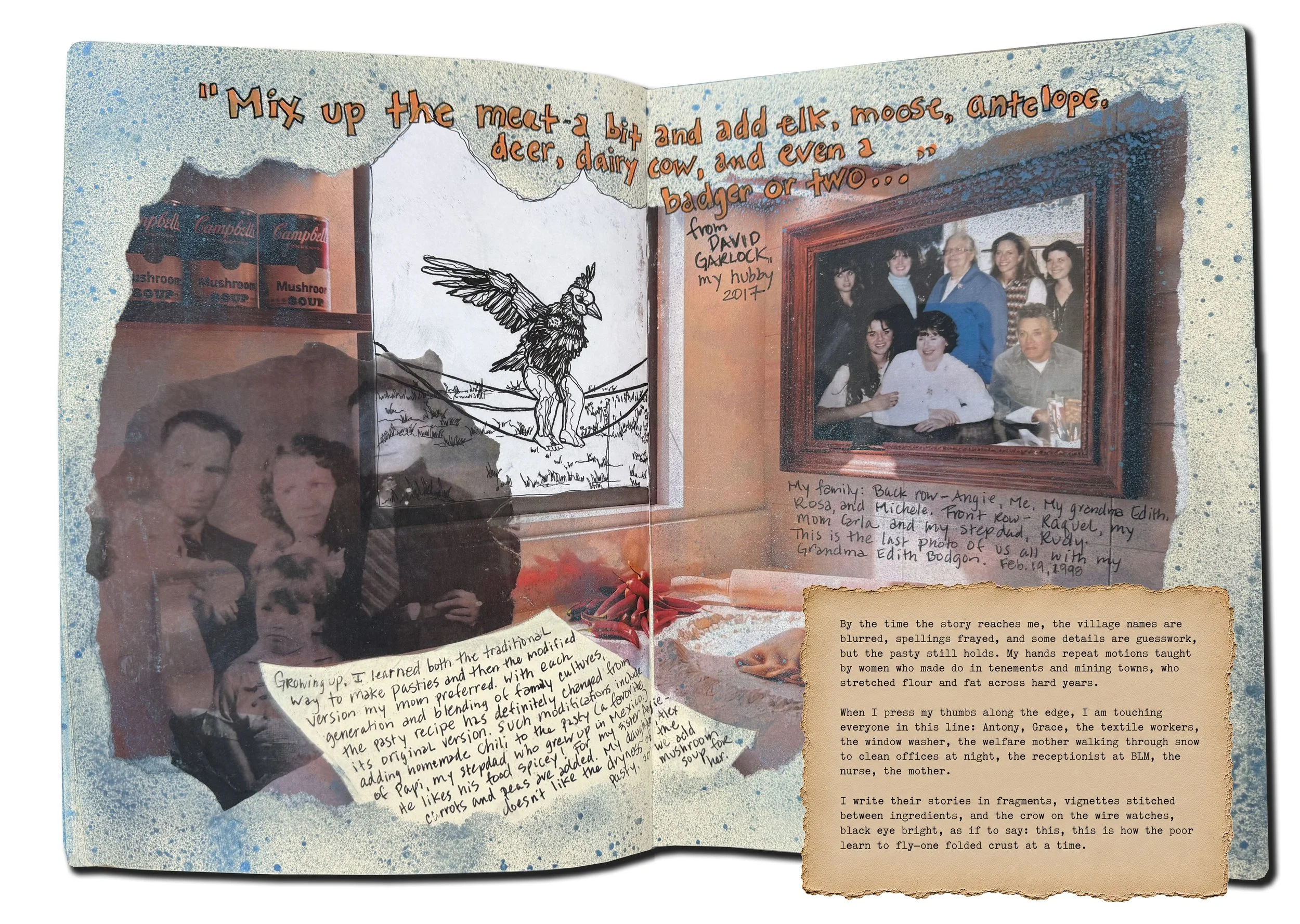
Liminal Birds, Salted Roots, Warm Hands Zine pages 15-16 - Candace Garlock 2026
By the time the story reaches me, the village names are blurred, spellings frayed, and some details are guesswork, but the pasty still holds. My hands repeat motions taught by women who made do in tenements and mining towns, who stretched flour and fat across hard years. When I press my thumbs along the edge, I am touching everyone in this line: Antony, Grace, the textile workers, the window washer, the welfare mother walking through snow to clean offices at night. I write their stories in fragments, vignettes stitched between ingredients, and the crow on the wire watches, black eye bright, as if to say: this, this is how the poor learn to fly—one folded crust at a time.
by Candace Nicol Garlock, Born 1966 in Elko, NV
This project was created for Around the Table, an initiative of free, public humanities-based programming in commemoration of the 250th anniversary of the signing of the Declaration of Independence. Throughout 2026, Nevada Humanities invites Nevadans to share and celebrate their diverse food traditions through a series of public events and creative reflections that explore Nevada foodways, food traditions, and expressive culture across the Silver State.
As part of Around the Table, Nevada Humanities invites Nevadans to contribute food stories and traditions in a new zine and recipe card collection housed in the Nevada Humanities archives.