
Once There Were Water Babies
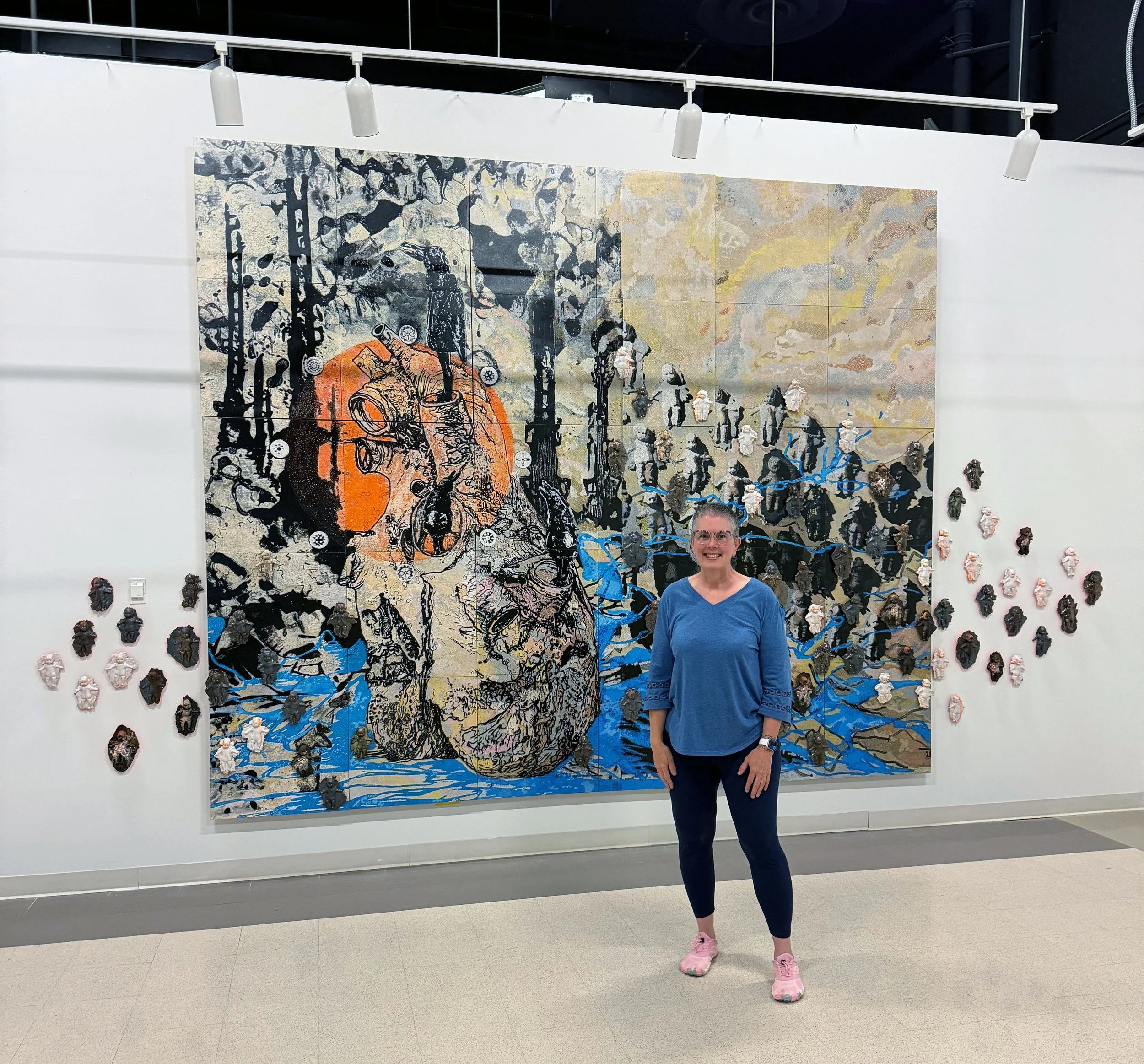
Installation View: Truckee Meadows Community College, Reno, NV 2026 Media: Acrylic on Wood, Ceramics, 10FT high x 17FT wide x 3IN deep.
This installation was inspired by a print I did in 2025:
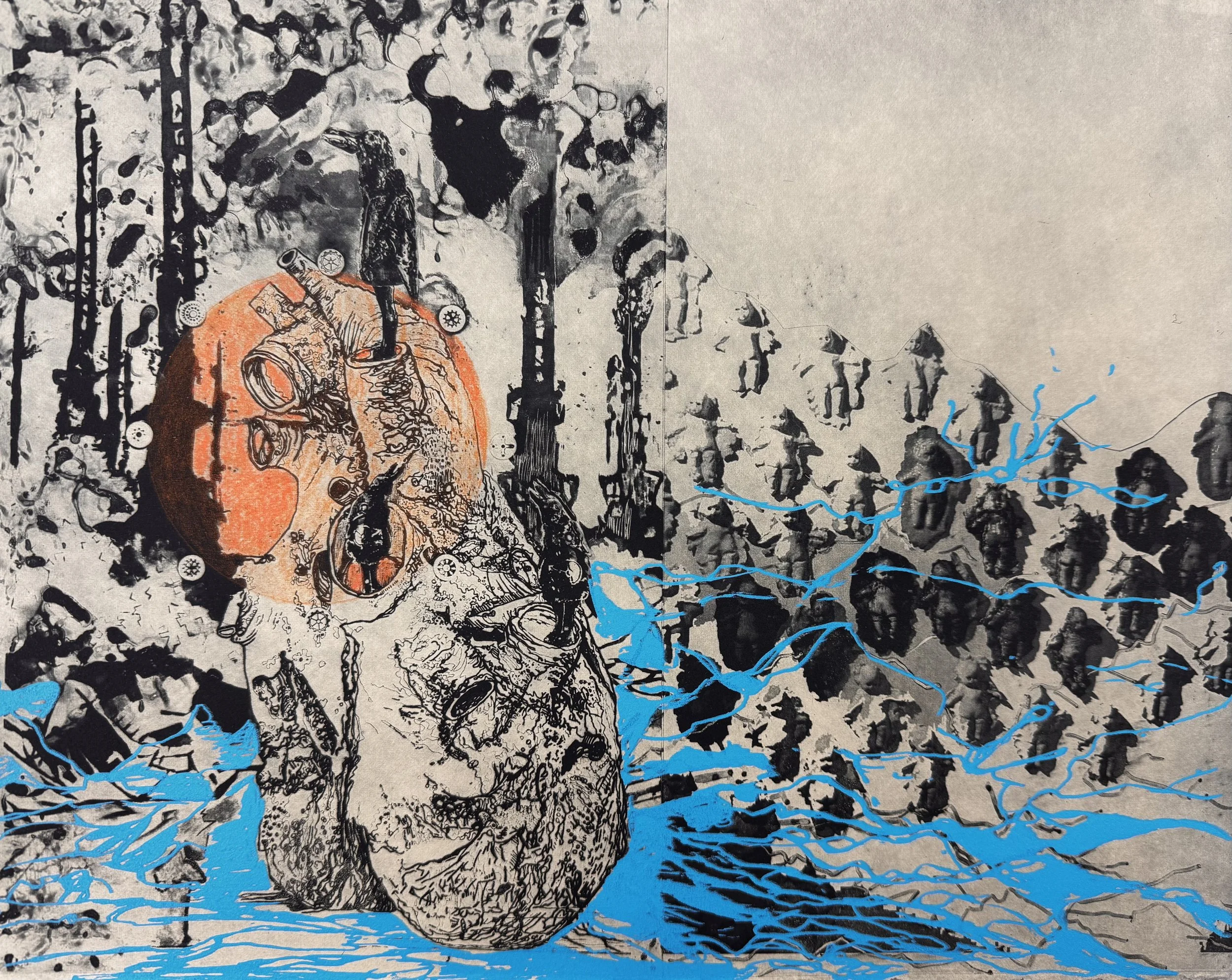
Once there were water babies. Photopolymer Intaglio, screenprint, colored pencil drawing on Rives BFK Tan paper. 11”x14”
“Once there were water babies.”
In a distant future where civilization has crumbled under the weight of environmental devastation, a desolate landscape emerges. This parched land, once vibrant with life, is now a barren wasteland, marked by cracked earth and remnants of plastic, steel and concrete. Amidst this desolation, the mutated raven people, known as the Corvidae, roam in search of lost humanity—both in the physical and spiritual sense.
The Corvidae, their bodies twisted and elongated from generations of adaptation to the harsh environment, mutated birds with human legs, temporarily shelter along the road to Terminus, a mythological resting space that never really appears. With feathers that shimmer in shades of charcoal and obsidian, they possess an uncanny intelligence and an ability to communicate through a complex language of caws and gestures. Their eyes, sharp and glimmering like shards of red glass, reflect desolation.
Along this road, a petrified blue whale heart is used for a shelter. These whales, once the largest animal on the planet, have long gone with the vanishing oceans. Their hearts weighing as much as 400 pounds, the size of a small car.
As scavengers, the Corvidae traverse the ruins of once-thriving cities, picking through the debris of human existence and in their search for artifacts, they seek to piece together the story of humanity’s downfall. Each item they find is a treasure, holding fragments of memories long forgotten. The Corvidae believe that by uncovering these remnants, they can reclaim the lost essence of humanity and restore balance to their world.
Yet, their quest is not without peril. The parched land is fraught with dangers, from toxic storms that sweep across the horizon to rival factions of mutated creatures that fiercely guard their territories. The Corvidae must rely on their cunning and teamwork to navigate these challenges, often forming alliances with other mutated beings in a delicate dance of survival. As they scavenge, they share tales of the past, weaving a rich tapestry of mythology that binds them together in their shared experience.
Finding a grave of plastic and ceramic spirit dolls, a group of Corvidae begin to unravel the mythology of water babies, piecing together stories gathered from collecting other remnants. The Island of the Dolls, located in the canals of Xochimilco, Mexico, is steeped in a haunting legend. According to the myth, a man named Julián Santana Barrera discovered a drowned girl and began hanging dolls from trees to appease her spirit and prevent further misfortune. Over time, the island became a macabre collection of dolls, believed to come alive at night. The water babies can be heard crying near edges of toxic lakes, luring creatures to their poisonous death below turquoise waters.
The Corvidae believe the road to Terminus will end and the earth will heal. They hold onto the hope that their scavenging efforts will one day lead to a rebirth, where the lessons of the past will inform a new, harmonious existence. This belief fuels their relentless pursuit, as they strive not only to survive but to understand the essence of what it means to be human. In this imagined realm, the Corvidae embody the duality of destruction and rebirth, serving as guardians of forgotten wisdom. Their journey through parched land is a testament to the enduring spirit of life, reminding us that even in the face of devastation, the quest for understanding and connection can lead to unexpected paths. Through their scavenging, they not only seek to reclaim lost humanity but also to forge a future where the scars of the past can be transformed into a foundation of something new.
NOTE: Corvidae is the scientific family name for a group of birds commonly known as corvids, which includes species such as crows, ravens, magpies, and jays. These birds are known for their intelligence, problem-solving abilities, and complex social structures.