The Raven - Pattern, Printing and AI
As part of a challenge for “Clothesline ’26” organized by Anna Newman and Ingrid Stumpf, I did something new. I fed a drawing into AI to help generate the actual sewing pattern, flattening a three-dimensional body I'd only seen in death into pieces I could cut and stitch. What used to take a trained pattern maker hours (a whole craft tradition of apprenticeship) took an afternoon.
A Show Rooted in Grassroots Fiber Community
Anna Newman and Ingrid Stumpf started an informal fiber club, Fiber Friday at the University of Nevada, Reno during their MFA program. At the time there was little textile-specific art activity on campus, so with the support of their faculty advisor Eunkang Koh, that club grew into the exhibition itself, founded in 2023 with Camryn Maher as one of its originators. The show's trajectory has tracked the growing seriousness with which fiber work is treated on campus and the Reno Community: what started in the McNamara Gallery expanded in 2025 into the Student Gallery South, a move made possible by longtime supporter Austin Pratt, UNR Galleries curator. That growth was accelerated by a 2024 summer residency at Holland Project called Hand Wash Only, pairing a fiber lounge, an inclusive community show called Patchwork, workshops, and a film screening with an invitational gallery show that matched artists with textile works from their own family history. Quilts, lace, stuffed toys, garments were made by people who considered themselves crafters rather than artists.
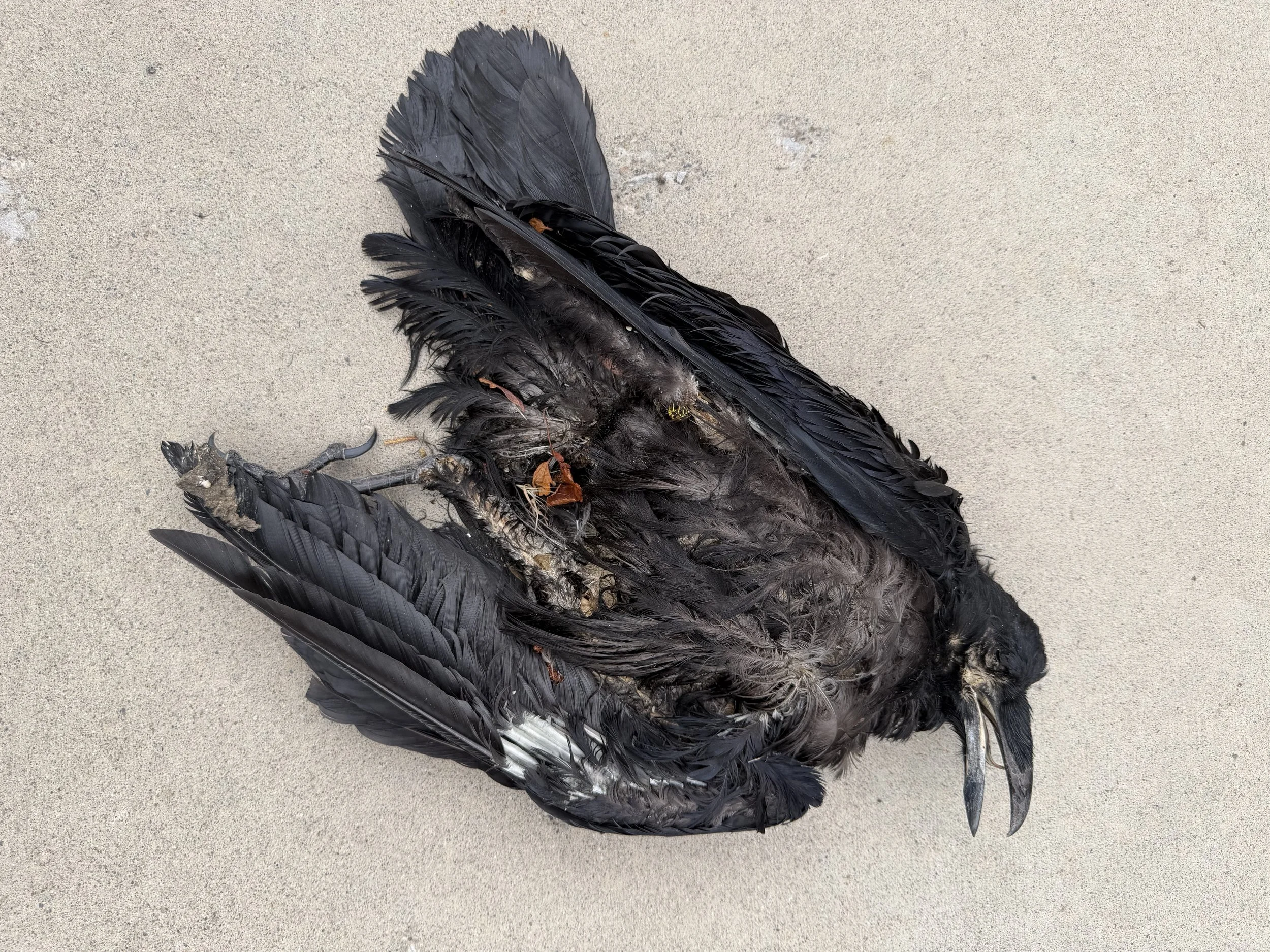
2026 photo of a raven on the sidewalk near our house.
Found him on my husband's walking path- a raven, wings folded, already becoming part of the ground. I couldn't look away. So I drew him: beak, wing, tail, the dense stipple of feathers turning back into earth.
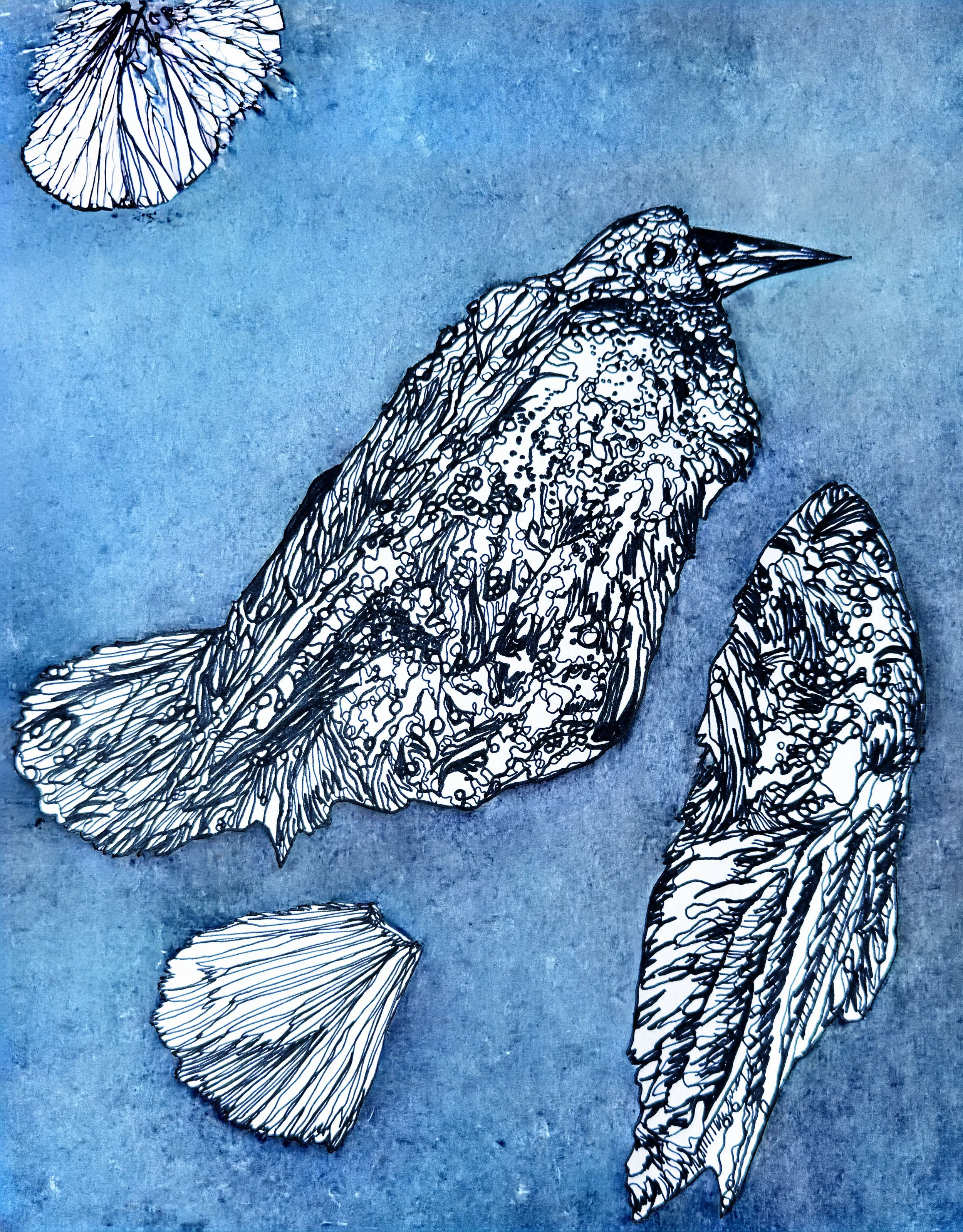
Candace Garlock, The Raven, Pen and Ink, 2026
The raven travels through observed death (a bird found on a walking path) and a hand-drawn anatomical study, into AI-assisted pattern generation, and finally into digitally printed fabric ready for construction. This pipeline compresses a process that traditionally took centuries to formalize (the translation of a three-dimensional body into flat, sewable pattern pieces) into a single studio session. Understanding what changed, and what was lost or gained in that compression, requires situating the work within the history of pattern drafting, the mechanics of digital textile printing, and the ongoing critical debate about authorship in AI-assisted art.
A Six-Hundred-Year Craft
Pattern-making has always been fundamentally a problem of translation: converting a rounded, moving form into flat shapes that, when stitched, reconstitute volume. The earliest surviving tailoring pattern book, Juan de Alcega's Libro de geometria practica y traca (1580), shows that even the origins of the craft were already systematized, but for centuries before and after, most tailors relied on "rock-of-eye" drafting- freehand chalk drawing guided by internalized proportion, learned through decade-long apprenticeship starting as young as age ten. This is strikingly close to the origin point of the raven work: a freehand ink drawing made by looking closely at a dead bird's actual body, letting the eye and hand find the proportions directly, no measurement system required.
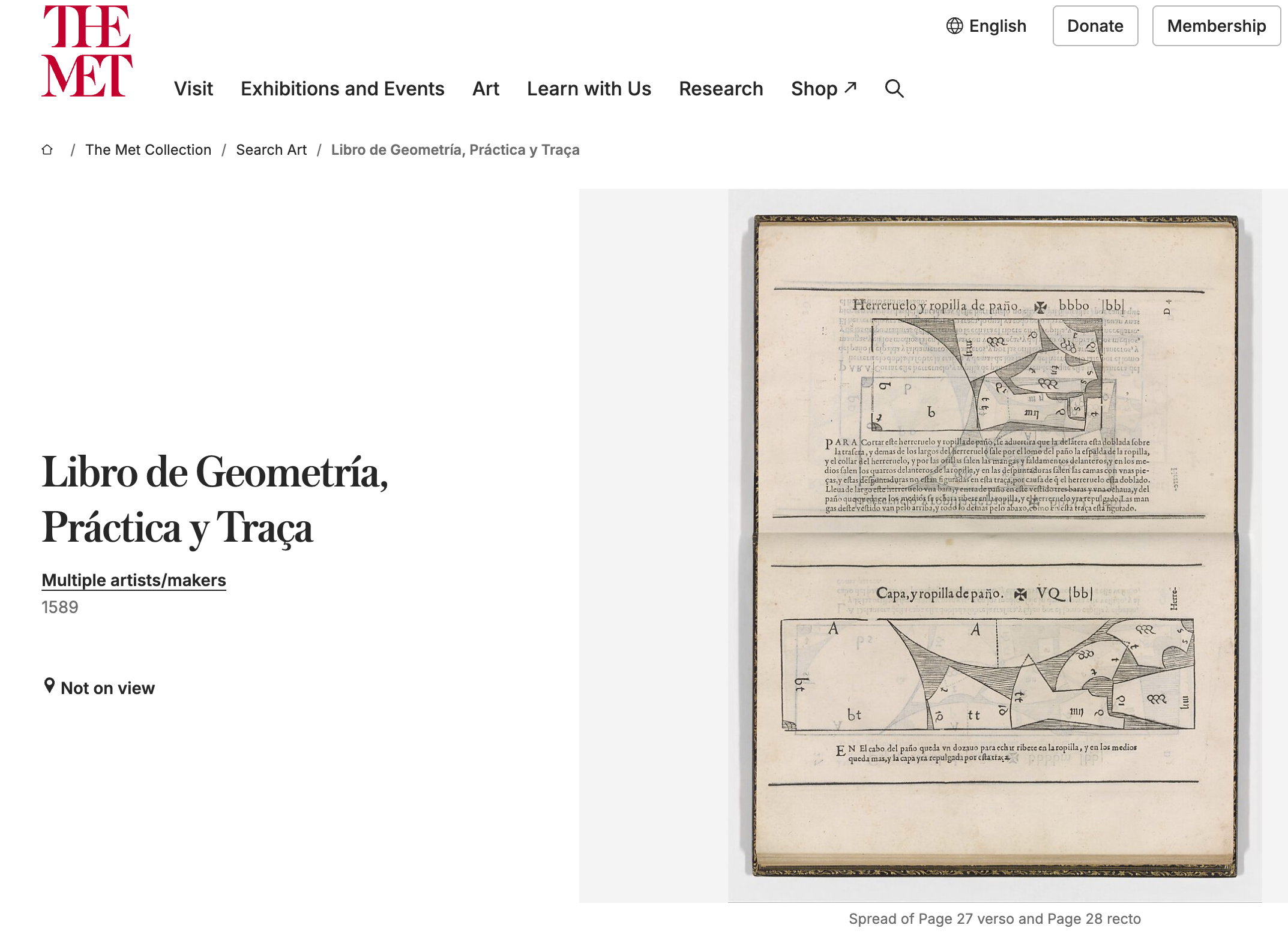
Title: Libro de Geometría, Práctica y Traça Author: Juan de Alcega (Spanish, born Guipúzcoa), Publisher: Guillermo Drouy (Spanish, active Madrid, 1578–99) Date: 1589, Medium: plates: woodcut Credit Line: Rogers Fund, transferred from the Library Object Number: 41.7)
By the late eighteenth century, tailoring knowledge began to formalize into proportional and direct-measure drafting systems, replacing intuition with ratios and arithmetic formulae that could be taught to non-specialists. Ebenezer Butterick's innovation of graded, mass-produced paper patterns in the 1860s democratized the process further, letting home sewers build garments without any drafting knowledge at all. Scholars of pattern history describe this as a shift "from conversational and suggestive" systems requiring the user's own prior knowledge, toward increasingly quantified, step-by-step instructions that removed ambiguity — and removed the maker's need for improvisation.
Computer-aided drafting (CAD) entered the industry in the 1970s, letting drafters generate and grade pattern derivatives from a stored parametric block rather than redrawing from scratch each time. This is the direct ancestor of the raven workflow's AI step: a base "block" or reference (in this case, a photographed and drawn bird) becomes source data that a system can manipulate, flatten, and reproduce. Traditional CAD pattern software still required specialist training to translate a design into cut-ready geometry. What has shifted in the last two to three years is the arrival of generative AI tools that accept a photograph, sketch, or even a text description as direct input and output structured, print-ready or CAD-compatible pattern pieces — collapsing the drafting step almost entirely.
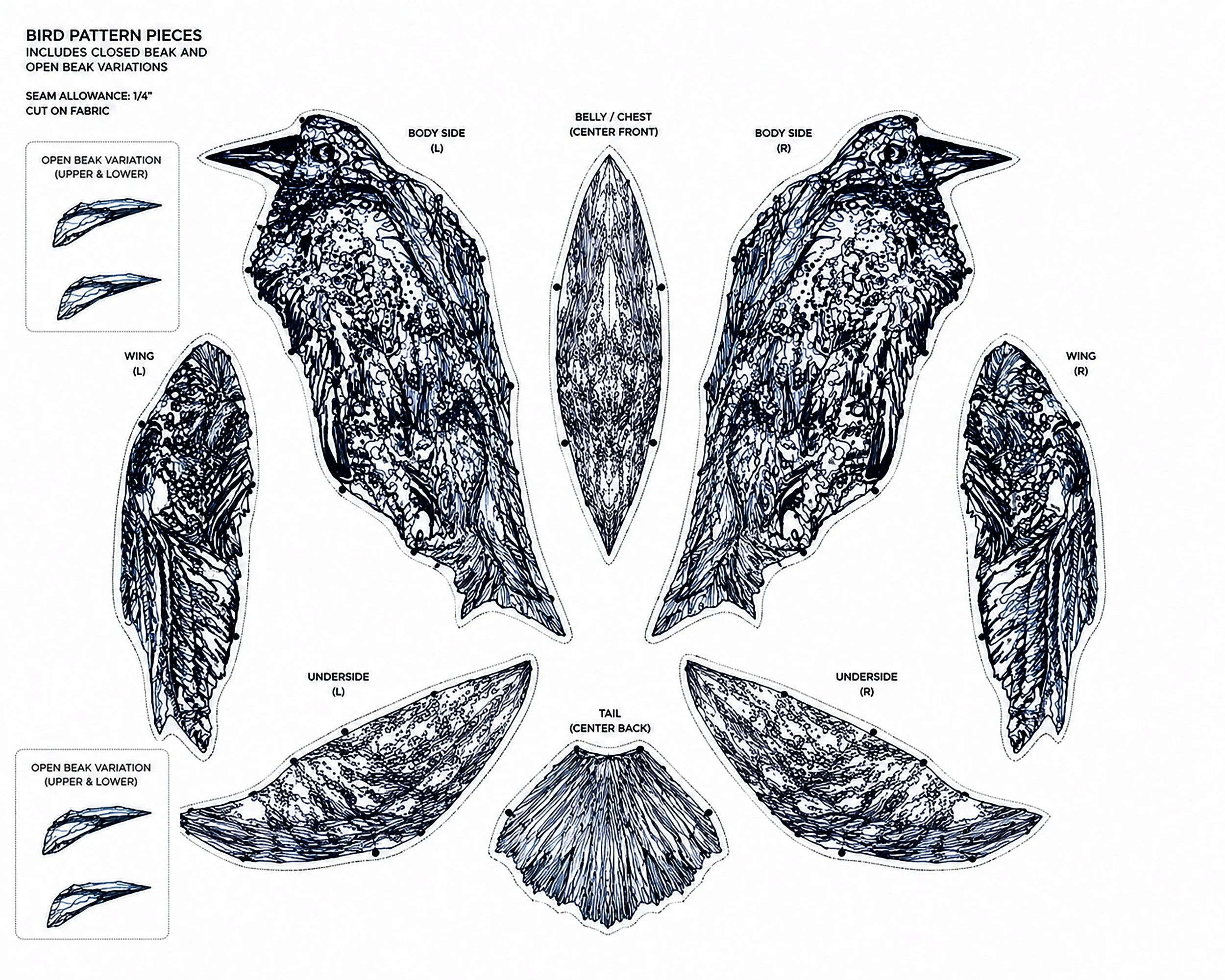
Platforms such as LA VIPÈRE create pattern generation from images and descriptions with mathematical accuracy.” The Raven pattern I created was from Chatgpt.
This matters for a practice like the raven series because it removes the single biggest historical bottleneck in pattern-making: the technical translation step between observational drawing and a cuttable, seamed shape. Where a nineteenth-century dressmaker needed years of apprenticeship, or a mid-century home sewer needed a purchased pattern, an artist today can move from an ink drawing of a dead bird to a labeled, seam-allowanced pattern piece (as visible in the "Bird Pattern Pieces" sheet, complete with a 1/4-inch seam allowances in a single AI-assisted prompt. The technical literacy bottleneck that once separated "someone who draws" from "someone who can construct" has narrowed substantially.
The freedom this affords is not simply speed; it is a freedom to keep the maker's hand in the observational and conceptual stages while assigning the geometric problem-solving to AI.
AI-based pattern generation offers a parallel kind of freedom from formula, but without needing the physical form present at every step: the reference photograph and drawing can stand in for the body, and the system extrapolates the flattened geometry from there. This is functionally similar to what industry commentary on generative AI in textile and fashion design calls its main strength, a rapid iteration and variation generation once a core visual direction is set, letting a maker test multiple structural or textural options before committing physical materials.
The raven pattern sheet shows this in miniature — variations like the "open beak" and "closed beak" alternate pieces exist as design options generated alongside the main pattern, a kind of built-in iteration that a hand-drafting process would have made costly to produce.
Any research narrative on this topic has to engage with the live debate over what AI assistance means for authorship and originality, because it bears directly on how the raven pieces can be framed critically. One position, argued in legal and philosophical scholarship, holds that generative AI tools are functionally no different from a paintbrush, camera, or Photoshop: they require a human author to supply "inspiration and design and directions," so the end-user remains the artist regardless of the tool used. A competing, more skeptical position argues that because AI outputs are trained on and remix existing works, the tool cannot originate new ideas, only recombine prior ones, which complicates claims of full originality.
I reject the binary and describe authorship in AI-assisted art as a collaboration between myself and AI. This framing fits the raven project closely: the photograph, the observational drawing, the selection of which anatomical fragments (wing, tail, beak, chest) to translate into pieces, and the final decision to have it printed on fabric are all human curatorial acts that bracket the AI step. The AI's contribution is confined to solving the geometric flattening problem the maker specified through the drawing itself.
I began to create Ai videos of what these fabricated birds would feel like in one of my constructed terminus environments. All the elements for the landscape were collaged into my sketchbook and acted as the backdrop for this exploration.
I used AI video rendering to help me visualize the actual form and movement of the bird in space. It was used as a brainstorming tool, but also created a bridge from my sketchbook drawings and collages to the sculptural bird that I wanted to sew.
Digital pattern projection systems developed for home sewing (e.g., Ditto a joint venture combining algorithmic measurement adjustment with a projector) make a similar argument in their marketing: that removing the manual drafting bottleneck is explicitly a tool "to enable creativity," letting the maker spend cognitive effort on design decisions (necklines, flares, proportions) rather than on geometric calculation.
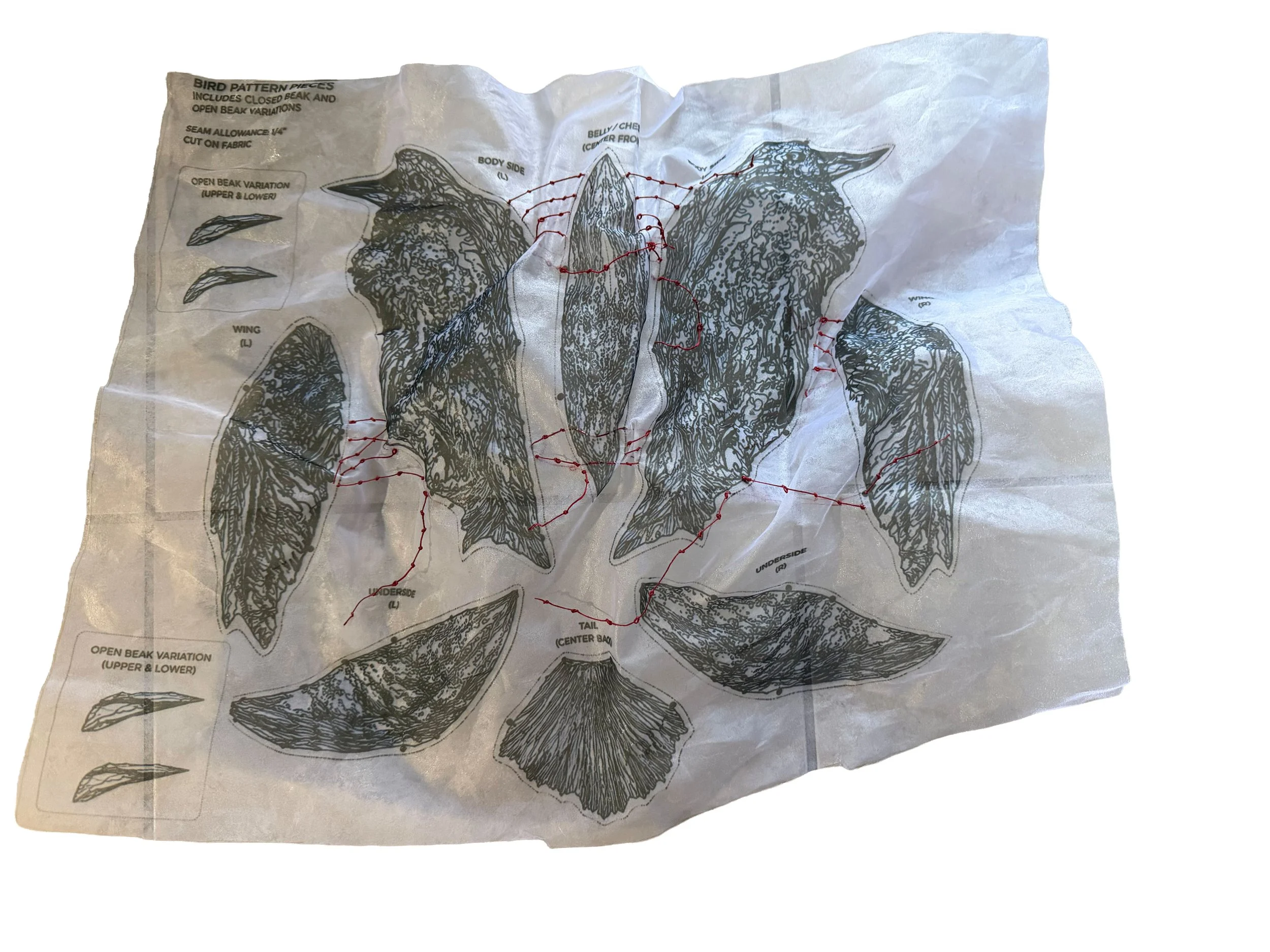
Printed fabric from Contrado with hand sewn elements.
Digital Printing
Sending the AI-generated pattern to be digitally printed on fabric is itself a technology that only became widely accessible to independent artists in the last two decades, allowing full-color, photographically detailed imagery (like the dense ink line work and stippling visible in the original drawing) to be reproduced at fabric scale without the register limitations of screen printing.
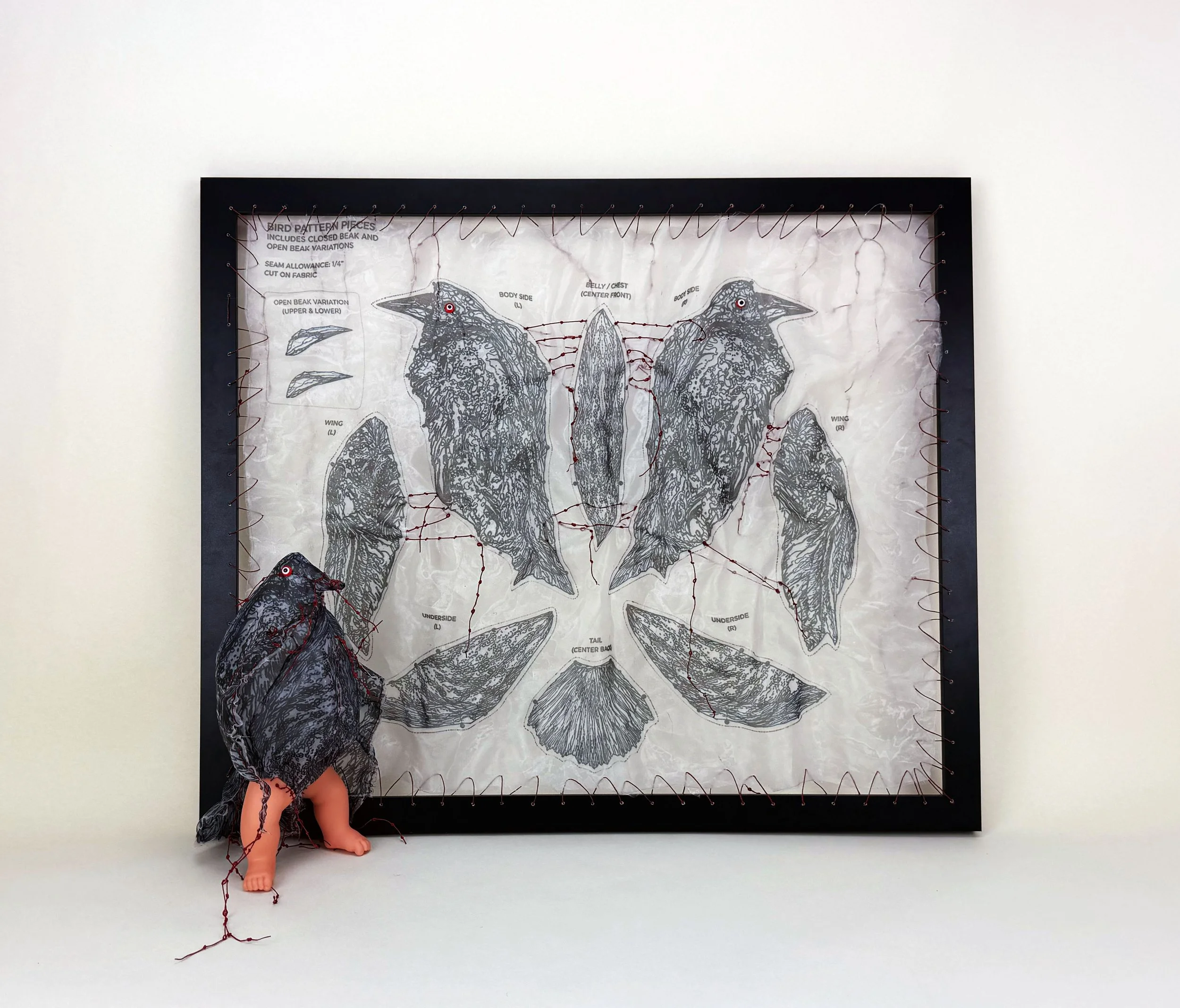
The Raven, Fabric, Plastic, Hand-sewn Thread, Wood Frame, 2026
The Hand to Sew
But the pattern is only ever a diagram until a hand closes the gap between paper and body. Every stitch in this last piece, like exposed capillaries, was placed by hand, slow and visible, refusing the smoothness a machine might make. AI could flatten the raven into geometry; digital printing could transfer the drawing onto cloth. But neither could close a dart, ease a curve around a doll's stolen limb, or decide, stitch by stitch, how much of the wound should show. That decision belongs only to the hand. The digital tools compressed hours of technical labor into an afternoon so that the labor that remained (the hand-sewing, the knotting, the visible red thread left trailing like a nerve or a root) could be slower and more deliberate. In the end, the AI didn't remove the handwork from this practice; it cleared space for it, insisting that whatever remains slow and hand-touched in the finished object is there because it was chosen, not because the technology could do it faster.