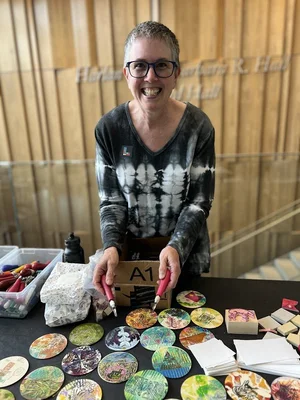
The Good, The Bad, The Ugly
This new addition, “The Good, The Bad, The Ugly” from the Road to Terminus series was created for LSU's 2026 portfolio exchange, Print Technology: Hybridization & Humanity, and takes as its starting point Donna Haraway's insistence that technology is not neutral — that we are inside of what we make, and it is inside us. Across the top part of the print, a dense archive of industrial harm (reactors, oil rigs, lead, gasoline, a watching camera) bleeds its toxic wash down into everything below it, refusing to stay contained to its own register. At the center, a medusa-crane hybrid creature behind a bioluminescent nerve rooted at its neck, an image of demyelination drawn from my own experience living with MS, standing in for the ugly, incurable cost that plastics and industrial toxins may quietly write into the body. Beside it, a length of hand-stitched thread spirals off the edge of the paper entirely, the one gesture in the piece that is not printed or mechanized, offering care and accompaniment rather than repair for a wound that will not close. Loosely built around The Good, The Bad, and The Ugly, the print resists keeping those categories separate. Technology here is system, body, and gesture all at once, and none of the three can be held apart from the others.
The Good, The Bad, The Ugly emerged during a period when I was grappling with workplace conflict surrounding environmental responsibility, institutional accountability, and personal safety. While raising concerns that a campus identifying itself as environmentally conscious was simultaneously permitting the regular use of plastisol inks and curing equipment without proper ventilation, I was met with hostility, including a colleague telling me that they "wished I would get sick." When I reported the incident, the response from administration felt dismissive, reinforcing a sense that both the safety concerns and the threat itself were viewed as insignificant. That experience became embedded in the work. Rather than documenting a single event, the print reflects the broader politics of institutional silence and how systems can normalize harmful conditions, minimize those who speak up, and leave difficult truths unresolved beneath the surface.
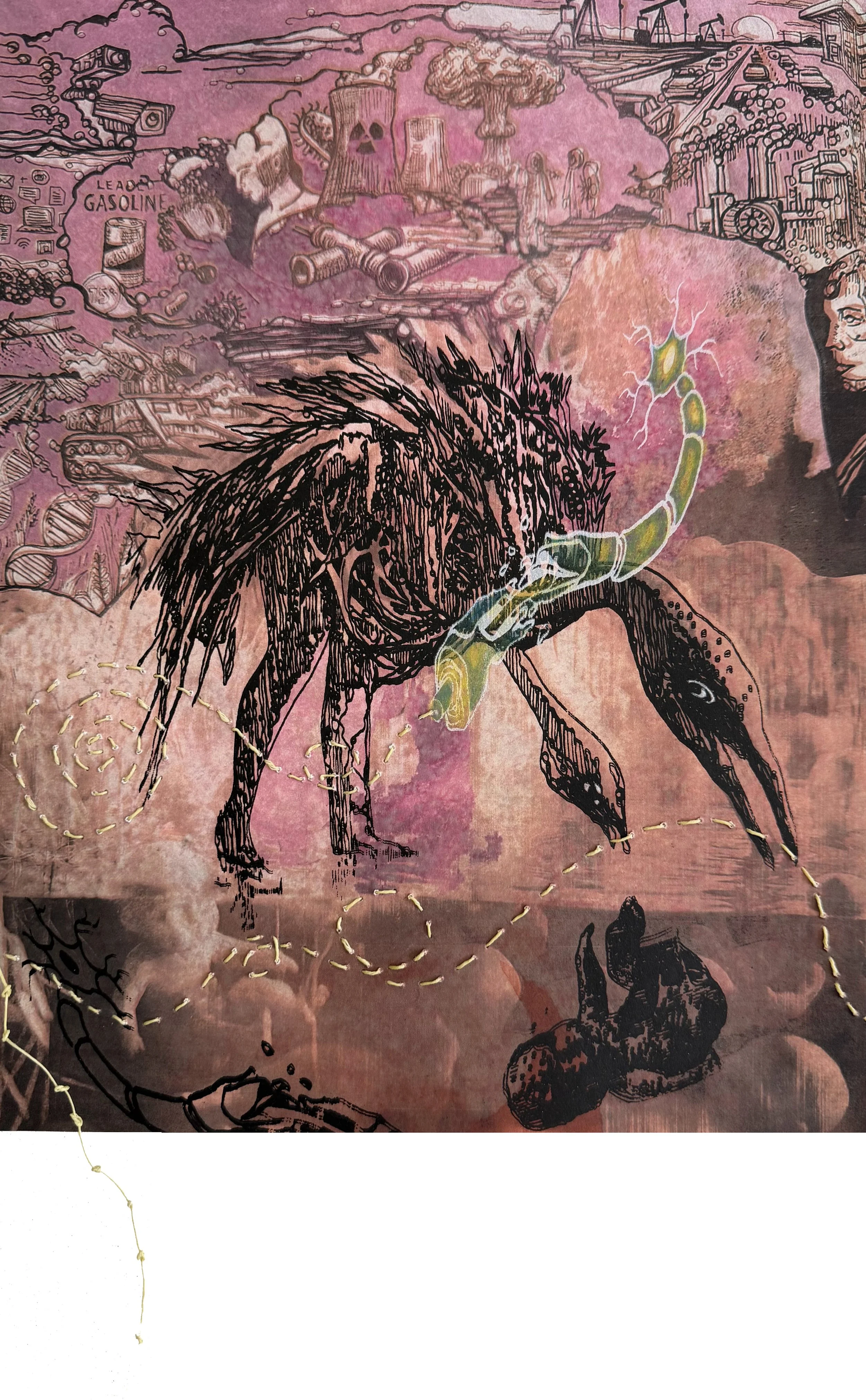
Candace Nicol Garlock, The Good, The Bad, The Ugly, Photopolymer Etching over Digital print, Screenprint, Hand-coloring and Stitching, Thread, 11”x14” 2026
Edition: 23, Artist Proof: 5, Trial Proof: 1
FOR: "MAPC 2026 PRINTELLIGENCE" conference, hosted by the Mid‑America Print Council at Louisiana State University's Barnes Ogden Art & Design Complex, running October 9–11, 2026: Permanent Collections: Mid-America Print Council and Louisiana State University. Edition 23: for traveling.
The Ugly perhaps, but a reflection of accumulation.
The top band in this print isn't a single event, it's an archive. Nuclear cooling towers sit beside oil derricks, factories, a mushroom cloud, lead and gasoline containers, a surveillance camera, a coiled double helix. These were chosen as symbols of change, both good and bad. They trace a genealogy of 20th-century "progress," each one a technology once marketed as liberation (cheap fuel, clean energy, genetic mastery, public safety) that later revealed its cost. Rendering them in the same obsessive, densely hatched line work as my other Terminus imagery puts them on the same evidentiary footing as historical illustration. This is my doodled landscape. The ghosted human profile at the right edge, faded almost to nothing against the pink, reads as the witness this deposition is for: an ancestor, a descendant, or simply memory itself, present but unable to intervene.
The Good: Thread as suture, not decoration.
Hand-stitching through a printed surface is historically a mending gesture — sashiko, boro, medical suture, quilting after loss. By running the thread past the edge of the paper entirely, I am refusing the idea that mending stays inside the frame. It suggests the repair work (attention, care, hand-labor) has to extend into the world the print hangs in, not just the world depicted on the sheet. It's also the only element in the piece with actual texture and shadow in physical space, which means it's the one part of the work that changes as gallery light changes, an ancient technology (needle, thread, knot) that stays alive and responsive, unlike the fixed technologies etched above it.
The wash that won't stay contained.
The magenta/orange haze isn't a backdrop, it's a contaminant, created by printing the first layer on a Canon printer that did NOT house fully permanent inks. When the paper was soaked before printing the etched layer, the ink bled, a symbol of flesh under stress, of a photograph left in the sun, of Cold War civil-defense film stock, a memory that seeps down into the middle and lower areas. The misalignment reads as a still shot of an old tube TV. That's the deepest formal argument the piece makes for Haraway's claim: the harm doesn't stay in its box. It tints the "good" gesture of the thread and the creature's "ugly" ambiguity in equal measure, because in her framework there is no clean zone standing outside the systems we've built.
The Nerve, Demyelination, and the "Ugly"
The bioluminescent tendril rooted in front of the creature's body isn't a generalized symbol of connection. It’s the demyelination process itself, rendered as if lit from within. In multiple sclerosis, the immune system strips the myelin sheath from nerve fibers, exposing and disrupting the signal beneath; there's no cure, only management. Drawing that process in an acid green-yellow against the black ink of the creature's body makes visible what is normally invisible and internal: a nerve laid bare, transmission compromised, the body's own wiring turned into evidence.
This image carries a personal weight beyond metaphor: the demyelination depicted here comes from my own experience living with MS, which is what grounds this piece's exploration of technology's cost in lived, embodied reality rather than abstraction.
This gives the "ugly" in a harder edge than ambiguity or hybridity alone. Rather than technology as abstract menace, it becomes technology as measurable, incurable, embodied cost- and one increasingly tied to exactly the materials represented in the top of the print. Recent research gives that link real weight rather than just poetic license: a 2024 Case Western Reserve study found that common household chemicals (organophosphate flame retardants and quaternary ammonium disinfectants, both byproducts of industrial and plastics manufacturing) directly impair oligodendrocytes, the cells responsible for building myelin, identifying this as "a previously unrecognized risk factor for neurological disease" (Multiple Sclerosis News Today). Separately, a Swedish study out of Uppsala University linked blood-borne PFAS and PCBs, persistent industrial and plastic-derived pollutants, to increased MS risk (Fox News), and researchers have also flagged BPA, a plastics compound, for triggering autoimmune responses against nerve sheaths (Dr. Kharrazian). None of this science claims plastics cause MS outright (the disease is still understood as multifactorial) but it confirms the plausibility of my inquiry: these are live, current research questions about whether the technologies etched into my print are quietly rewriting the nervous systems of all living beings.
Read this way, the tendril collapses the distance between the archive above (nuclear, oil, lead, gasoline, plastics) and the body below, not as a general claim about humanity, but as my own body's relationship to that archive. It's no longer just "technology inside the creature" in the abstract Haraway sense, it's a specific, contemporary, unresolved medical question made personal.
Those Baby Dolls never go away.
Fragments of lost baby dolls lie partially submerged beneath the creature’s feet, forming a kind of sediment layer, a buried record of what has been left behind but has not disappeared. Referencing the mythology of Once There Were Baby Dolls, these figures have shifted from imagined beings into plastic remnants, objects that resist decay even when buried, forgotten, or folded back into the earth. Like plastic in compost, they remain unresolved beneath the surface. Their presence suggests that what we inherit and discard does not simply vanish; it becomes part of the ground beneath us.
Reframing the triad.
Rather than three separate zones, the composition argues that Good, Bad, and Ugly are stages of the same entanglement viewed at different points of contact. The Bad is technology encountered as system (impersonal, historical, accumulating), the Ugly is technology encountered as body (internalized, ambiguous, load-bearing), and the Good is technology encountered as gesture (a hand, a needle, a repair extended past the frame). None of the three is allowed to exist in isolation from the others, which is exactly Haraway's point.